Blog
Guide to choosing the right size of clothes for 3 year old children
Jun
At the age of 3, your baby is growing rapidly in both height and weight. This is the time when your baby is very active, his body shape changes constantly, making choosing the right size of clothes important to ensure comfort and confidence. Through this article, Rabity will provide a detailed guide to help parents choose the size of clothes for 3-year-old children .
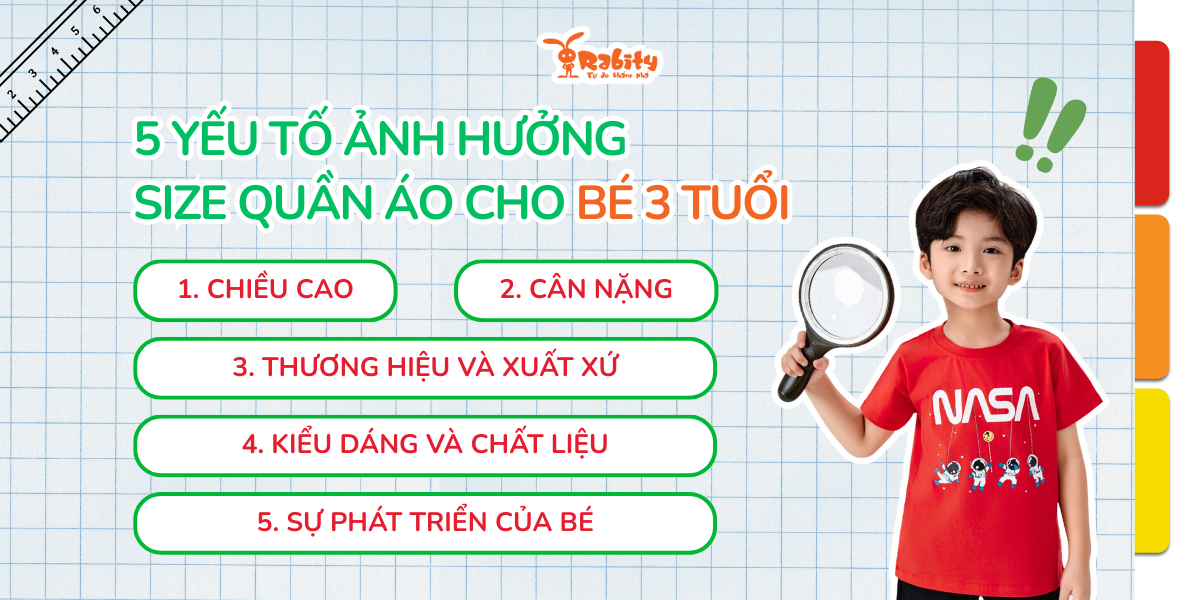
1. Factors affecting clothing size of 3 year old children
- Height : The average height of a 3-year-old child ranges from 92-100 cm depending on gender and growth rate. This is the main factor that determines the length of clothing.
- Weight : The average weight of a 3-year-old child is usually between 13-16 kg. Children of different weights will need the right size of shirt or pants so that they are not too tight or too loose.
- Brand and origin : Each brand has its own size chart, especially clothes from countries like America, Europe or Asia, often differing by 1-2 cm. Parents should check the size chart of each brand.
- Style and material : Tight-fitting clothes (leggings, t-shirts) often require more precise sizing than loose-fitting clothes (dresses, jackets). Stretchy materials like cotton and spandex also affect fit.
- Baby’s development : 3-year-old babies develop unevenly. Some babies grow tall but are thin, while others are chubby but short. Therefore, the actual measurements of the baby are the most important factor.
2. Reference clothing size chart for 3 year old children
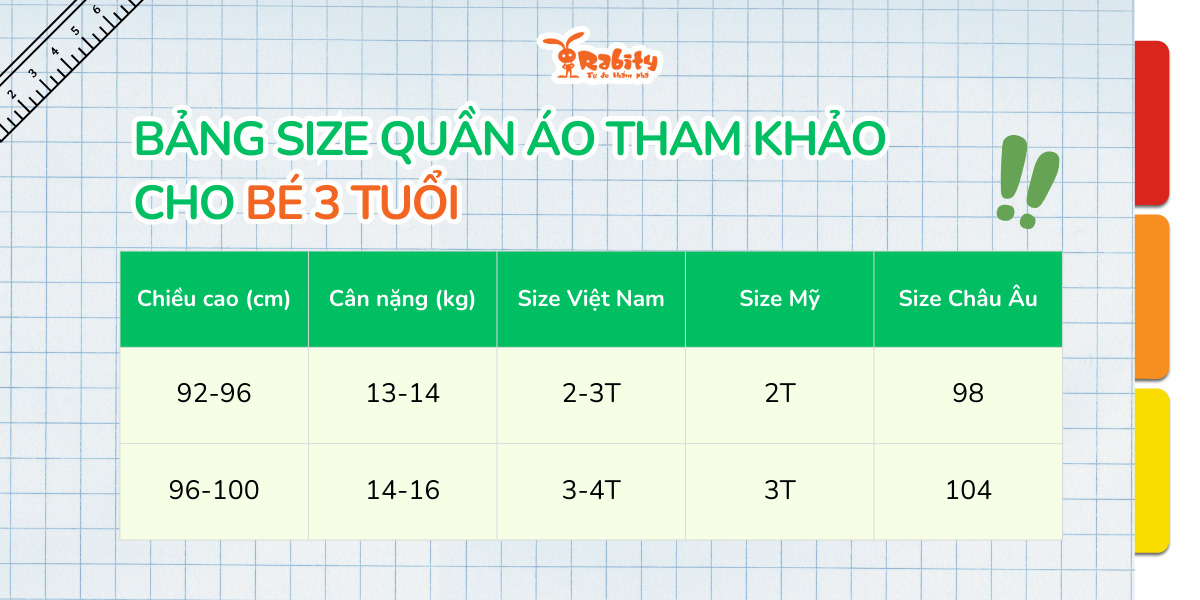
Based on data from reputable health organizations such as WHO, the average height and weight of a 3-year-old child is as follows:
- Boys : Height 94-100 cm, weight 13.5-16 kg.
- Girls : Height 93-99 cm, weight 13-15.5 kg.
Reference size chart:
| Height (cm) | Weight (kg) | Vietnam Size | US Size | European Size |
| 92-96 | 13-14 | 2-3T | 2T | 98 |
| 96-100 | 14-16 | 3-4T | 3T | 104 |
3. Detailed instructions on how to measure clothing sizes for 3 year old children
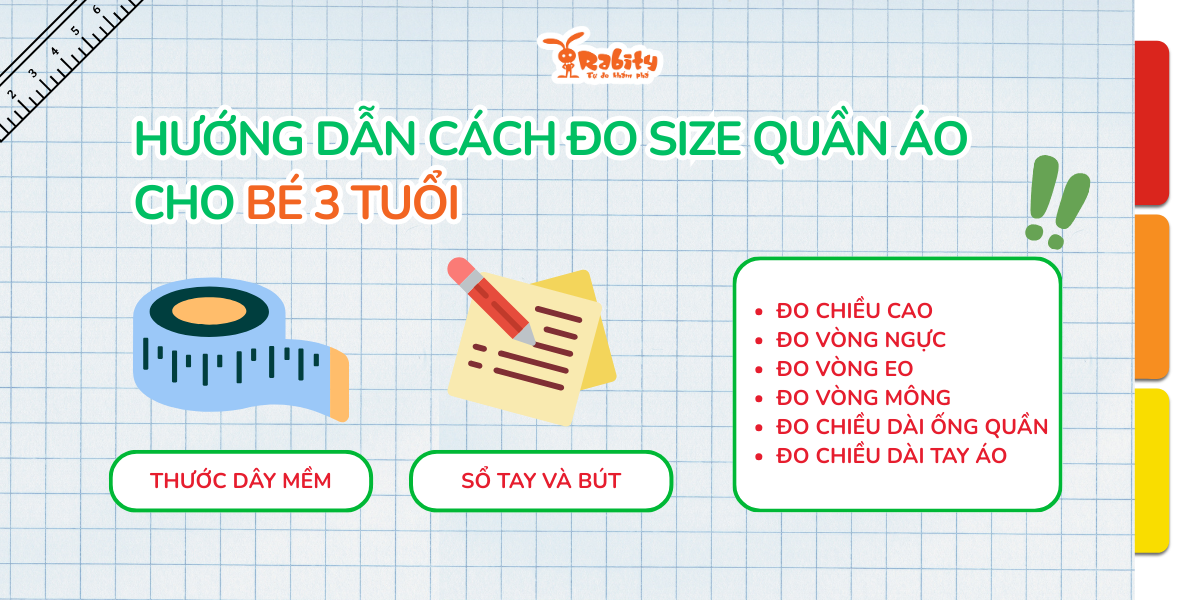
Tools needed:
- Soft tape measure (used in sewing).
- Notebook and pen to record measurements.
- Baby wears thin clothes for more accurate measurements.
Measurement steps:
Measure height :
- Have your baby stand up straight, back against the wall, legs together.
- Use a ruler to measure from the top of your head to your heels.
Bust measurement :
- Wrap the measuring tape around the fullest part of your baby’s chest, across the armpits.
- Make sure the horizontal tape measure is not too tight.
Waist measurement :
- Measure around natural waist (usually just above belly button).
- Hold the tape measure comfortably without tightening.
Hip measurement :
- Measure around fullest part of buttocks.
- Make sure the tape measure is not skewed.
Measure the length of the pants :
Measure from waist (or waistband) to ankle or desired length.
Measure sleeve length :
Measure from the top of the shoulder to the wrist, with the baby’s arm hanging naturally.
Tips for accurate measurement:
- Measure when baby is standing straight, relaxed, not tensing up.
- Do not pull the tape measure too tight or leave it too loose.
- Measure 2-3 times and take the average measurement to ensure accuracy.
- If your baby is active, you can measure while he or she is sleeping or have someone hold the baby.
4. Special notes on clothing sizes for 3-year-old girls and boys
At age 3, children’s clothing sizes usually do not differ much between boys and girls, because the average height and weight are quite similar. However, the styles may differ, for example: girls’ clothes often have ruffles and flared skirts, while boys tend to wear shorts and active T-shirts.
Some girls have wider hips, so when choosing pants (especially leggings or jeans), parents should prioritize hip measurements to avoid tightness. For boys, the chest and shoulders are often wider, so pay attention when choosing shirts.
If your baby has a special body shape (tall, thin or chubby), parents should choose clothes with adjustable straps (elastic-waisted pants, button-down shirts) for easy customization.
